California’s Apprenticeship System Blueprint

2026 Apprenticeship Policy Blueprint: Building a Cohesive Apprenticeship Ecosystem for California’s Future
March 6, 2026
The state of California has long been a national leader in developing high quality apprenticeship programs, particularly in the area of the building trades. However, as the various sectors of California’s economy diversify and evolve, so too must our approach to developing earn-and-learn apprenticeship pathways. Promising pilot programs in health care, technology, and climate resilience have begun to emerge across the state, yet all too often these pilot programs are difficult to scale and are disconnected from one another. What California needs now is a more cohesive apprenticeship ecosystem and a clear policy blueprint to guide the reforms required to build it.
Apprenticeships offer paid, debt-free pathways to high-quality careers while meeting employers’ real workforce needs. But unlocking the full potential of a statewide apprenticeship network requires intentional, intergovernmental, and intersectoral coordination across our education, labor, and workforce systems in conjunction with strong private sector (employer) partnerships. NextGen, in coordination with workforce leaders, on-the-ground practitioners, educators, and policymakers, is advancing systems reform in the apprenticeship space. By hosting a series of convenings, with more planned in the coming months, NextGen is cultivating greater alignment, shared problem-solving, and durable change among this large group of stakeholders.
In developing the 2026 California Apprenticeship Ecosystem Blueprint, NextGen consulted a broad coalition of partners committed to that vision, including Jobs for the Future, Apprenticeships for America, CareerWise USA, Alex Hussain, and many others. Together, these thought leaders bring deep expertise across policy, practice, and implementation, demonstrating that meaningful reform is a collective endeavor.
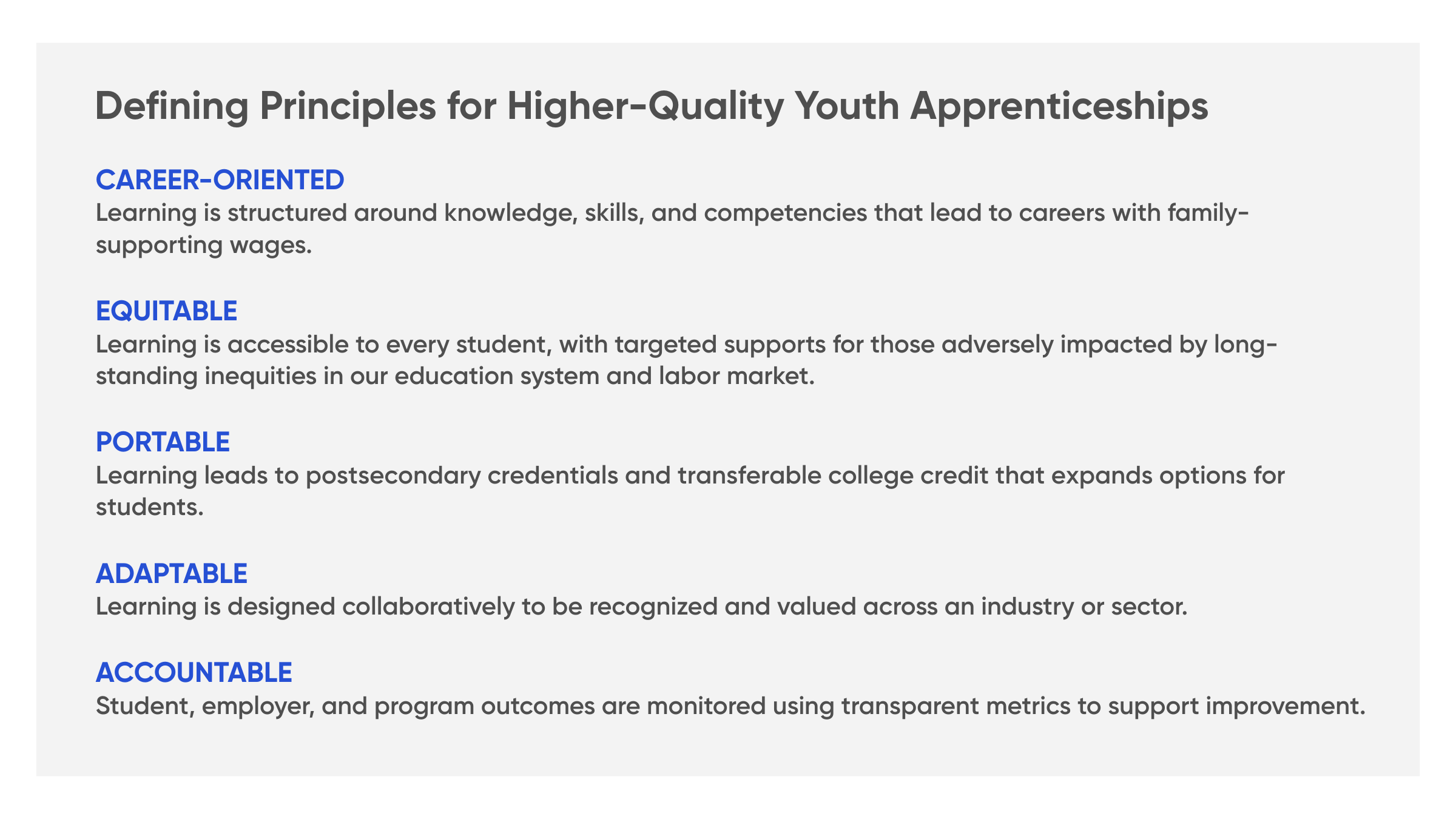
At the heart of this blueprint are the nationally recognized principles developed by the Partnership for Advancing Youth Apprenticeship (PAYA) to ground this work in a framework that ensures expansion goes beyond isolated programs and achieves true systems change. These principles provide a common north star for designing apprenticeship systems that are career-oriented, equitable, portable, adaptable, and accountable.
Youth Apprenticeship & Pathway Design (K-16 Alignment)
The first section of our blueprint focuses on youth apprenticeship and pathway design, with a strong emphasis on K-16 alignment. California currently lacks a clear, unified definition of youth apprenticeship, resulting in fragmented pathways and unnecessary barriers for schools and employers. Our blueprint calls for adopting a statewide framework, scaling proven models like the Career Apprenticeship Bridge, and aligning K-12, community colleges, workforce boards, as well as employers around seamless, stackable pathways.
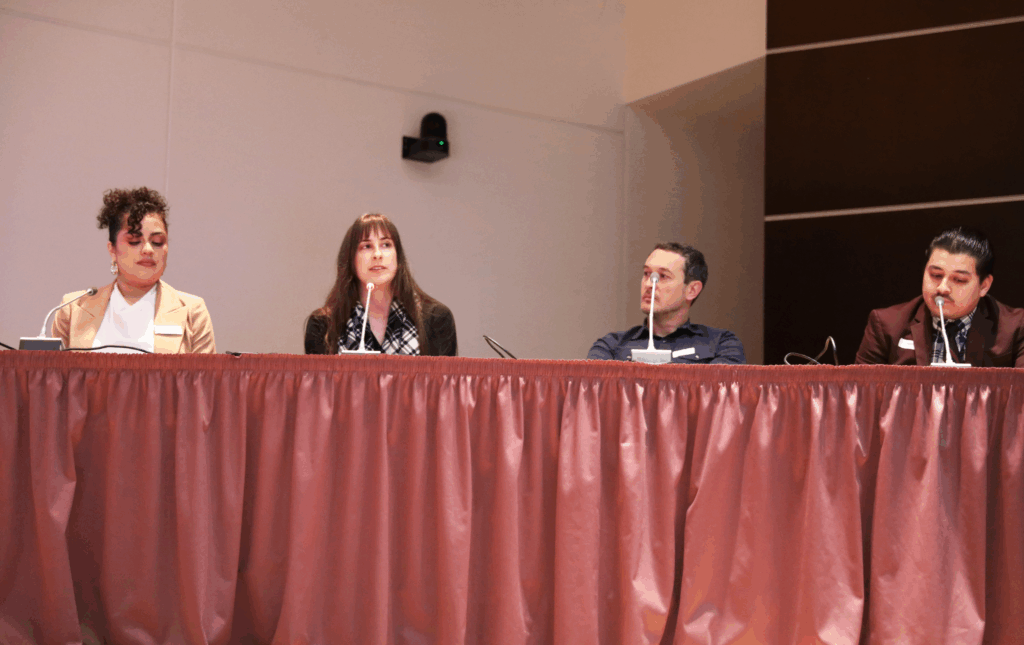
These recommendations are already gaining traction through two critical legislative vehicles: SB 845 (Pérez) and AB 805 (Fong), which codify many of these concepts into state law. The need for and momentum around these two bills was on full display at the January 21st Youth Apprenticeship Summit, a convening co-hosted with the California Workforce Association and CareerWise USA. That event brought together legislators, state agencies, intermediaries, and practitioners to break down silos and advance a shared vision for youth apprenticeship statewide.
Employer Engagement, Intermediaries & Public-Sector Leadership
The second section of our blueprint addresses one of the most persistent challenges in nontraditional apprenticeship: employer capacity. Most employers, especially small and mid-sized ones, cannot design and operate apprenticeship programs on their own. Intermediaries play a critical backbone role, yet they remain under-resourced and inconsistently funded.
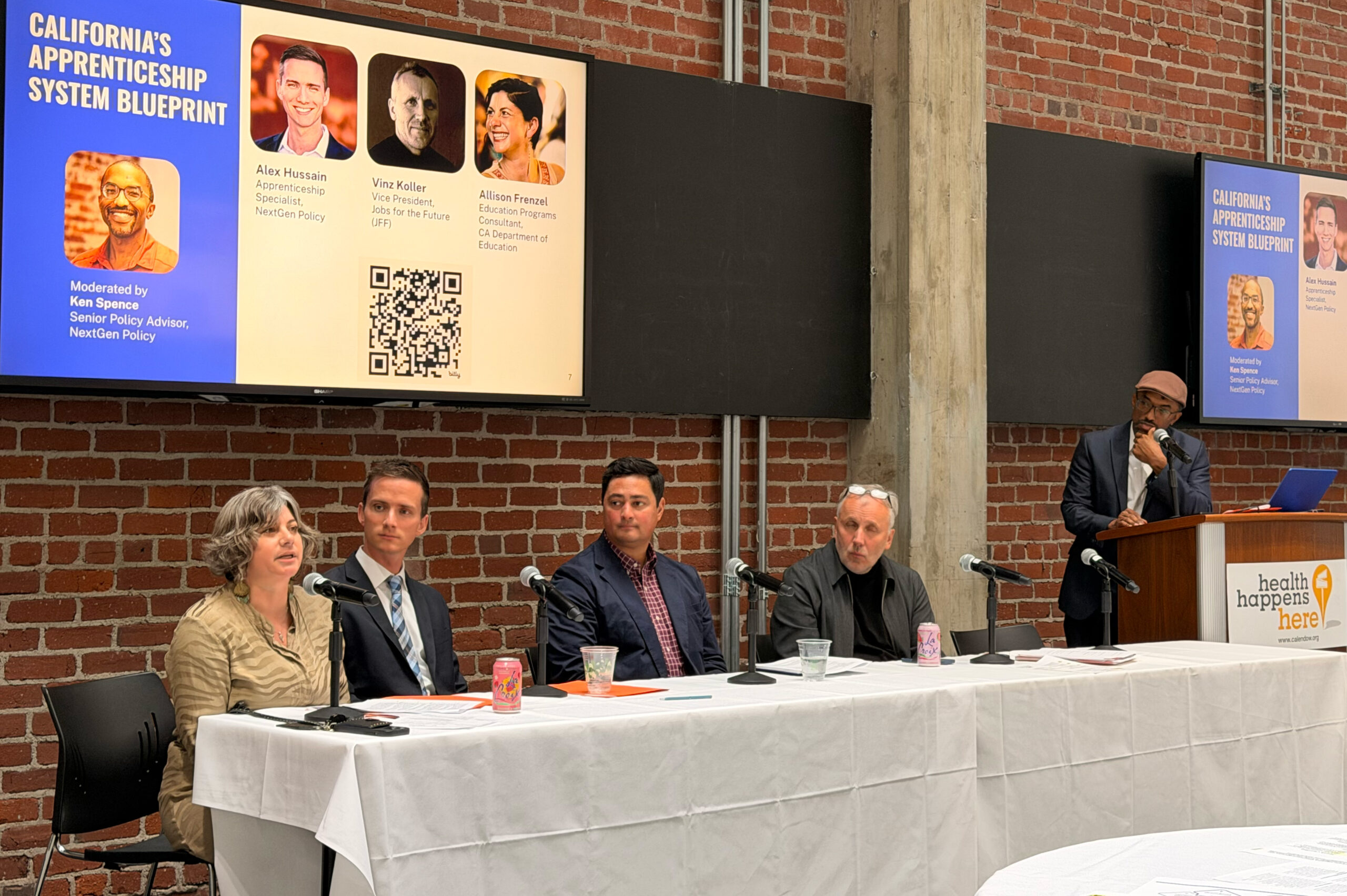
These issues were front and center at the December 8th convening, “Expanding California’s Apprenticeship System: Economic Mobility for All,” which featured panels with national and regional leaders, state officials, and intermediaries working on the front lines of apprenticeship expansion. We’re calling for sustained investment in intermediary capacity, clearer public-sector apprenticeship targets, and stronger accountability to make the public sector an anchor employer that normalizes apprenticeship beyond construction.
Sustainable and Aligned Funding
No system reform can succeed without consistent funding year after year. Today, apprenticeship funding in California is spread across multiple programs in various departments and overly reliant on short-term grants. Our blueprint’s third section emphasizes the urgent need for sustainable and aligned funding, beginning with the renewal of the Apprenticeship Innovation Fund (AIF) which expires this year. Reauthorizing AIF would stabilize programs, support multi-year cohorts, and enable long-term employer engagement, particularly in nontraditional apprenticeship sectors.
Beyond AIF, we’ve outlined pathways toward formula-based funding, better braiding of existing resources, and permanent financing mechanisms that reward collaboration rather than competition.
Next Steps
Our blueprint is not an endpoint, it is much more of an initial roadmap for action and collaboration. We invite those interested in this topic to join us in person at an upcoming convening as we continue to build this coalition and move from vision to implementation. We are also proud to share that we’ve recently received a Spark Grant from the Michelson 20MM Foundation to support this coalition-building work. That investment will help us ensure the blueprint meaningfully guides our efforts in the months and years ahead.
California has the talent, the innovation, and the will to build a world-class apprenticeship ecosystem. With shared principles, aligned policy, and sustained investment, we can ensure that our apprenticeship system delivers on its promise for learners, employers, and the state as a whole.
Thanks for reading,
Kami Peer
