
May Revise 2026

Let’s Talk… May Revise 2026
NextGen Takes a Closer Look at the Governor’s May Budget Revision
May 28, 2026
Governor Gavin Newsom kicked off the final phase of the 2026 state budget process by releasing his final "May Revise" budget proposal on May 14th. The revisions that are proposed in May to the Governor’s January budget proposal play an enormous role in the process of negotiating and finalizing the state’s annual budget, as described in a previous Let’s Talk blog post.
Details of the 2026 May Revision
In presenting this year’s May Revision budget, Governor Newsom made it clear that he’d like to leave a solid fiscal foundation for whoever succeeds him in the Governor’s Office next year – similar to the strong fiscal conditions that former Governor Brown handed off to him when he became Governor in 2019.
The May Revise proposal reflects substantial increases in projected state revenues compared to the Governor’s January budget proposal. Across the three-year period comprising the state budgets for 2024-25, the current state budget for 2025-26, and the upcoming state budget for 2026-27, revenue projections are $16.5 billion higher than in January. Capital gains from the stock market’s unusually strong performance over the past few years, and particularly the flurry of AI-related investment activity, are the primary driver of these incredibly positive state revenue trends.
Despite the increased revenue projections, the 2026 May Revise proposal generally emphasizes fiscal restraint, with relatively few new spending proposals and a mix of spending reductions, revenue increases, and reserve withdrawals to bring the state budget into balance over the next two fiscal years.
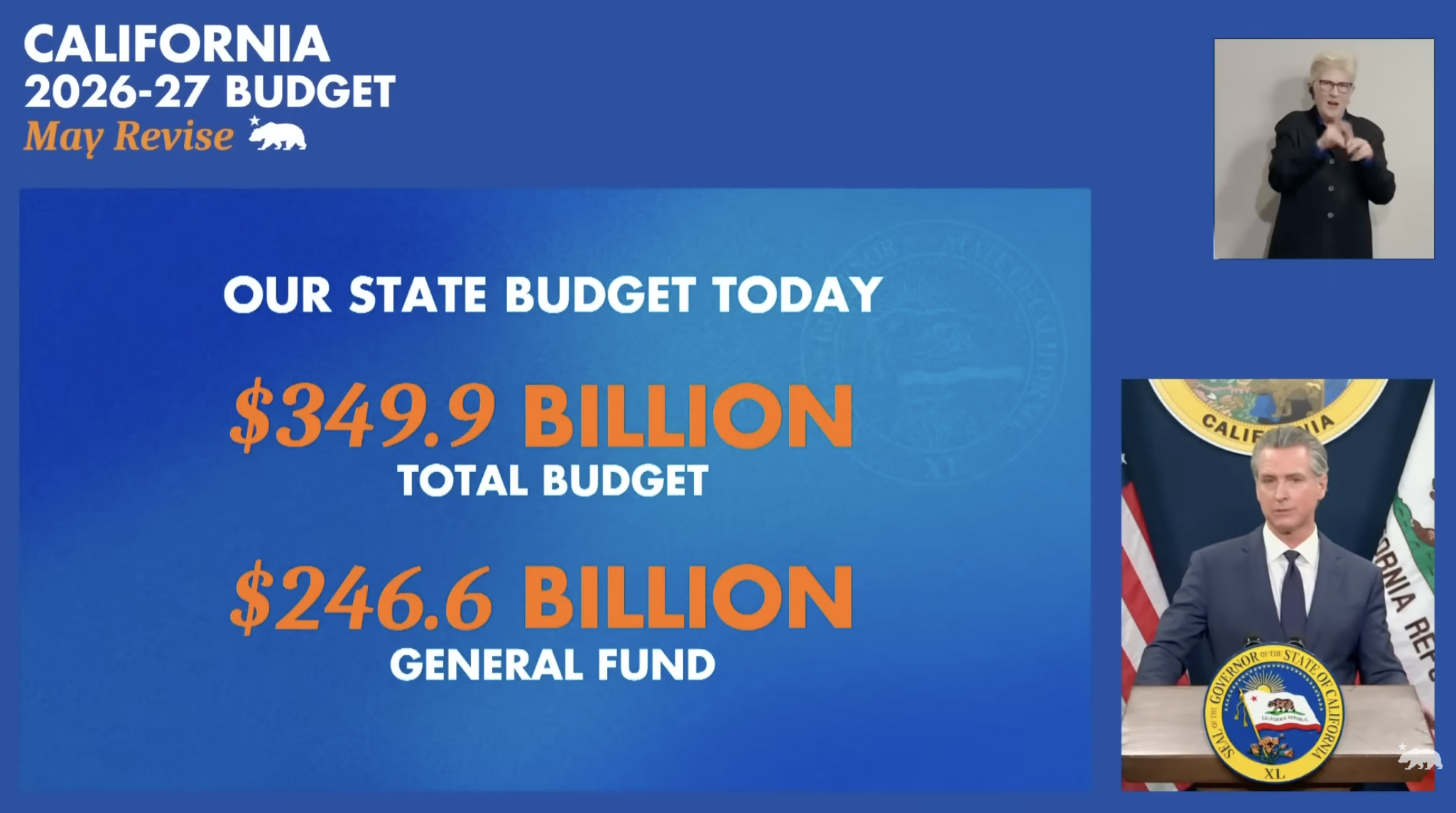
Total general fund expenditures under the Governor’s proposal would be $246.6 billion, which is roughly $1.8 billion lower than projected in the January budget – this fiscal plan keeps state general fund expenditures essentially flat in relation to the current enacted budget. Unlike many previous budgets during times of growing revenues, the Governor proposed very few proposals for state spending on new programs. No substantial new funding proposals were proposed in the areas of climate, housing, and infrastructure, among others.
The May Revision also includes spending cut proposals, many of which involve Medi-Cal, the federally-funded health program for low-income Californians. Specifically, the Governor’s proposal projects budget savings based on policies that would increase premiums paid by some immigrant populations enrolled in Medi-Cal, disqualifying some current Medi-Cal enrollees from eligibility by revising asset limits, and reducing Medi-Cal coverage and benefits for some immigrant populations.
Proposed revenue increases in the May Revise would be generated from a variety of sources: capping the amount of tax credits that can be claimed in a year by the state's largest corporate taxpayers, expanding state and local sales taxes to apply to digital software that is downloaded or provided as an online service, and renewing a tax on managed care organizations.
Additional budget balancing is proposed through a combination of withdrawals from the state’s so-called “rainy-day” reserve fund and delaying some required deposits into that fund,
Through this combination of spending cuts, revenue increases, programmatic changes, and use of reserves, the Governor has proposed a budget that he projects will eliminate state deficits in each of the next two fiscal years and substantially reduce the "structural deficits" confronting the state over the longer-term.
The May Revision contains relatively few new spending proposals. Among the handful of new proposals in the May Revision, the Governor is proposing to use, for the first time, a holding account that allows the state to set-aside projected surplus revenues for up to a year to hedge against the risk that large projected revenue spikes may not materialize. The May Revision also reflects an intention to seek voter approval for changes to the rules governing the state’s rainy day reserve fund that would allow the state to set-aside greater amounts of revenues. Additionally, proposed changes to some state housing programs would seek to incentivize local governments to reduce or waive fees that they impose on some types of new affordable housing development projects.
With the Governor’s reluctance to propose new funding in this year’s budget, the May Revise proposal contains relatively modest wins for programs in NextGen’s priority issue areas. These successes include:
- Funding support to start the implementation of the newly established federal Workforce Pell Grant program, which benefits older and returning higher education students seeking to improve their job and economic opportunities through short-term workforce education programs.
- Ongoing support for California’s groundbreaking programs to support food security by providing universal, free, healthy school meals to all California students.
- Additional resources to defend the legal rights of California’s immigrant communities, including those facing immigration court proceedings.
Next Steps
It is important to note that the release of the May Revise is far from the final word on the state budget. Over the next several weeks, Legislators and the Governor will engage in intensive negotiations to finalize a state budget proposal that can pass the Legislature by the Constitutionally mandated deadline of June 15th and be signed into law before the beginning of the new fiscal year on July 1. During these upcoming weeks, Legislators will have a chance to assert their own priorities and negotiate suggested changes to the Governor's May Revise proposal.
During this final part of the budget process, Legislators and the Governor are going to hear from many Californians and their deep concerns about the proposal’s reliance on budget savings from Medi-Cal service and eligibility reductions that will have substantial negative effects on some seniors, immigrant communities, and disabled Californians. Local governments are also voicing concerns that the proposed budget does not provide sufficient resources to address the local government fiscal impacts of federal changes to Medi-Cal and CalFresh programs. These stakeholders argue that the state needs to find a different combination of revenue increases and spending reductions to avoid the worst impacts from these cuts to safety net services.
However, some stakeholders in the state budget process are concerned that the May Revision does not go far enough in cutting spending and raising new revenue to prepare the state for the next economic downturn. There is a widely held belief that the current surge in revenues is likely to be followed by a steep drop in revenues sometime in the next couple of years, which will require the state to build more reserves and find additional ways to balance the long-term structural deficit. For example, initial comments on the May Revision from the Legislative Analysts’ Office recommended that the state budget should include an additional $20 billion in combined spending reductions and revenue increases to place the state on a more sustainable fiscal path.
The final budget will likely be shaped by policymakers’ efforts to address the many competing tensions posed by the May Revise proposal.
Sources for Additional Information
If you want even more detailed information about the California State Budget process as well as the May Revision, here are some important sources for you to check out before a new budget is (likely) passed by the June 15th deadline and signed into law by July 1st:
Department of Finance (DOF)
- A summary and full details of the revised budget can be accessed through the Department of Finance’s budget website.
- Finance letters contain the details of each of the administration’s proposed amendments to revise the Governor’s proposed January budget, as reflected in the budget bill.
Budget change proposals (BCPs) are documents submitted by state agencies and departments that propose changes to the level of service or funding source for a currently authorized program or propose a new program. A full list of this year’s BCPs that identifies which BCPs are related to the May Revise can be found here.
Legislature
- The Assembly Budget Committee’s website contains information about the full committee and subcommittee hearings on the state budget as well as documents and reports relating to the current and past-year budgets, including a summary of this year’s May Revise proposal.
- Similarly, the Senate Budget and Fiscal Review Committee’s website contains information relating to the committee’s budget hearings as well as information about current and historic budgets, including a summary of this year’s May Revise proposal.
Legislative Analyst’s Office (LAO)
- Dozens of LAO reports analyzing various aspects of this year’s state budget, including a response to the May Revise proposal, can be found on the LAO’s 2026-27 Budget page.
Thanks for reading,
Brian Weinberger
