
2026 Facts about Restrictive Voter ID
Facts about Restrictive Voter ID
A measure to require voter ID will likely appear on the 2026 California ballot. Here’s what you need to know about the ballot measure, privacy concerns, and the impact on voter participation rates.
What would the ballot measure do?
The ballot initiative would require government-issued ID at the polls or the last four digits of a government ID when voting by mail. It also would mandate annual reports from each county on the percentage of their voters with verified citizenship.
Current federal law already requires identity verification during the voter registration process. The voter registration form asks for a social security number, driver’s license or California identification card number. Additionally, applicants attest under penalty of perjury that they are a U.S. citizen. If an eligible citizen does not provide an ID number, a county elections official will follow up with the individual to ensure they provide a valid form of ID that meets the Help America Votes Act (HAVA) standards.
The proposed ballot measure is part of a larger attack on voting rights in our country. At the federal level, Congress has been debating the SAVE Act, which would upend the voter registration process and shrink the electorate. Read more about the SAVE Act here.
Potential Privacy Concerns
The proposed ballot measure raises privacy concerns and exposes voters to identity fraud risk with the requirement to write the last four digits of a voter’s Social Security Number or government ID on the vote by mail envelope.
Potential for ID Based Disenfranchisement
Strict ID requirements can disenfranchise eligible voters who may struggle to obtain a government ID card in time to cast their vote, or not have one on their person when they go to vote. Several barriers can stand in the way of someone obtaining a government ID card:
- Logistical Barriers: Obtaining an ID can entail many steps and red tape to procure the necessary documents (especially when it involves a legal name change) to establish identity. Individuals can get stuck in a loop of needing ID to obtain another form of ID. For example, to obtain a Driver’s License or State ID card, an individual needs a U.S. passport or birth certificate. To get a U.S. passport, a birth certificate is required. To complete a mail application for a birth certificate, an individual must provide a state or federal ID to a notary. Without these documents, a person must bring two witnesses to a notary who will swear under oath to their stated identity. These witnesses must both have government ID.
- Financial Barriers: Free or reduced cost IDs are available for seniors and low-income Californians, but the underlying documents required can pose a financial burden (i.e. a U.S. passport costs $130 or a birth certificate costs $29+) and can be time consuming to obtain.
- Geographic Barriers: In some of the more remote counties, the DMV office is inaccessible by public transportation for a portion of the population. Obtaining ID can involve a multi-hour trip made possible by a ride from a friend or family member.
Impact of Restrictive ID Requirements on California Electorate
NextGen Policy has conducted an original analysis of California eligible voter survey data to better understand who this will impact and potentially disenfranchise in our state. The analysis is based on 443 eligible voters in California who identified their race and ethnicity as part of the American National Election Studies (ANES) 2024 Time Series Study.
Nearly 1 in 10 eligible California voters lack an unexpired Driver’s License or State ID card.
- An estimated 2.4 million eligible California voters (or 9%) do not have an unexpired Driver’s License or State ID card, the most common forms of government identification that people are likely to carry in their wallet when they go to vote. Many more have a government ID, but it does NOT match their current name or address.
People of color are more than twice as likely to not have an unexpired government issued ID.
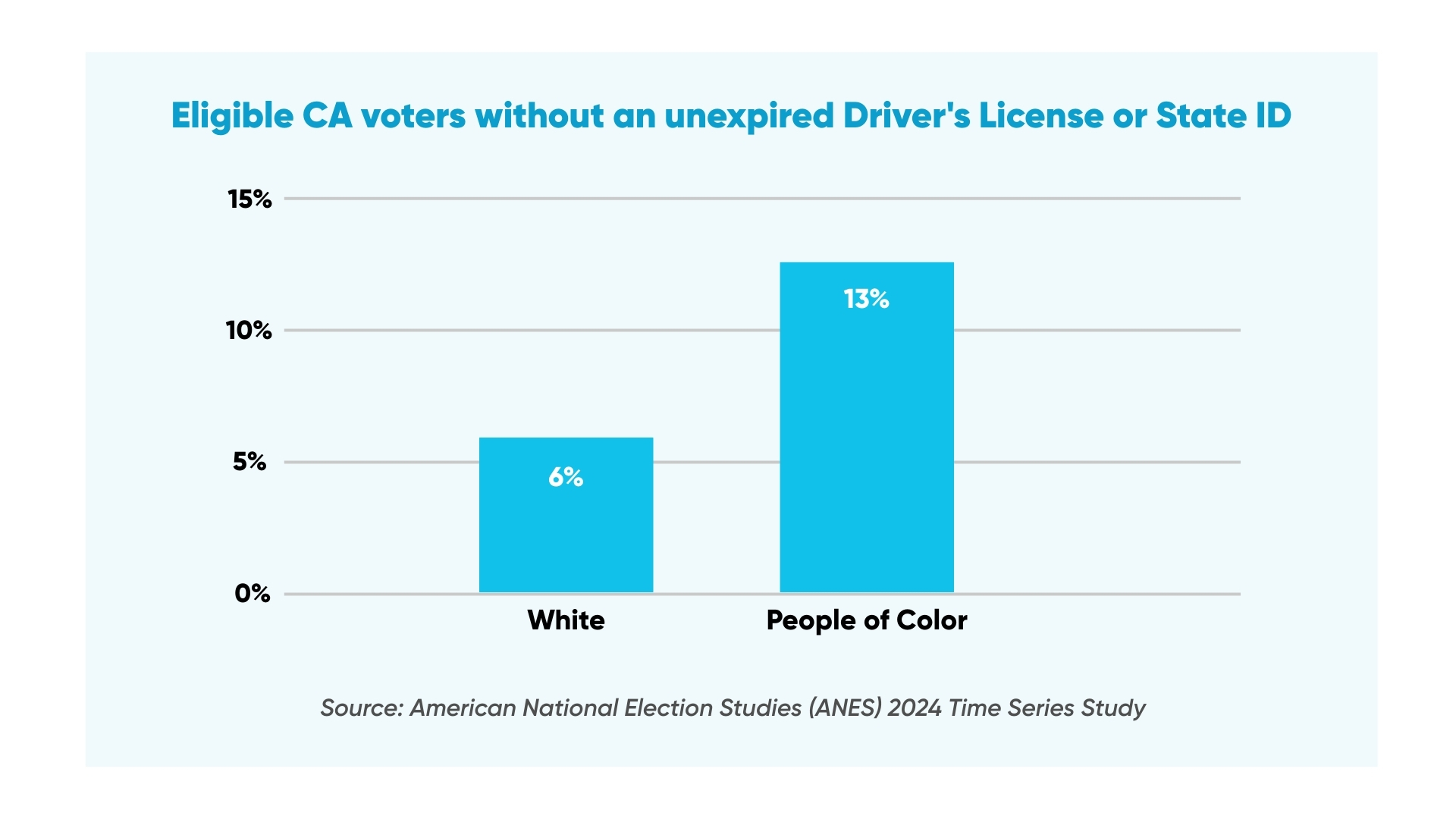
Data Source: American National Election Studies (ANES) 2024 Time Series Study Full Release [dataset and documentation], August 8, 2025 version. The nationwide survey included 443 eligible voters in California who identified their race and ethnicity. www.electionstudies.org